

Enter Faeryland: Seeing Through The Veil
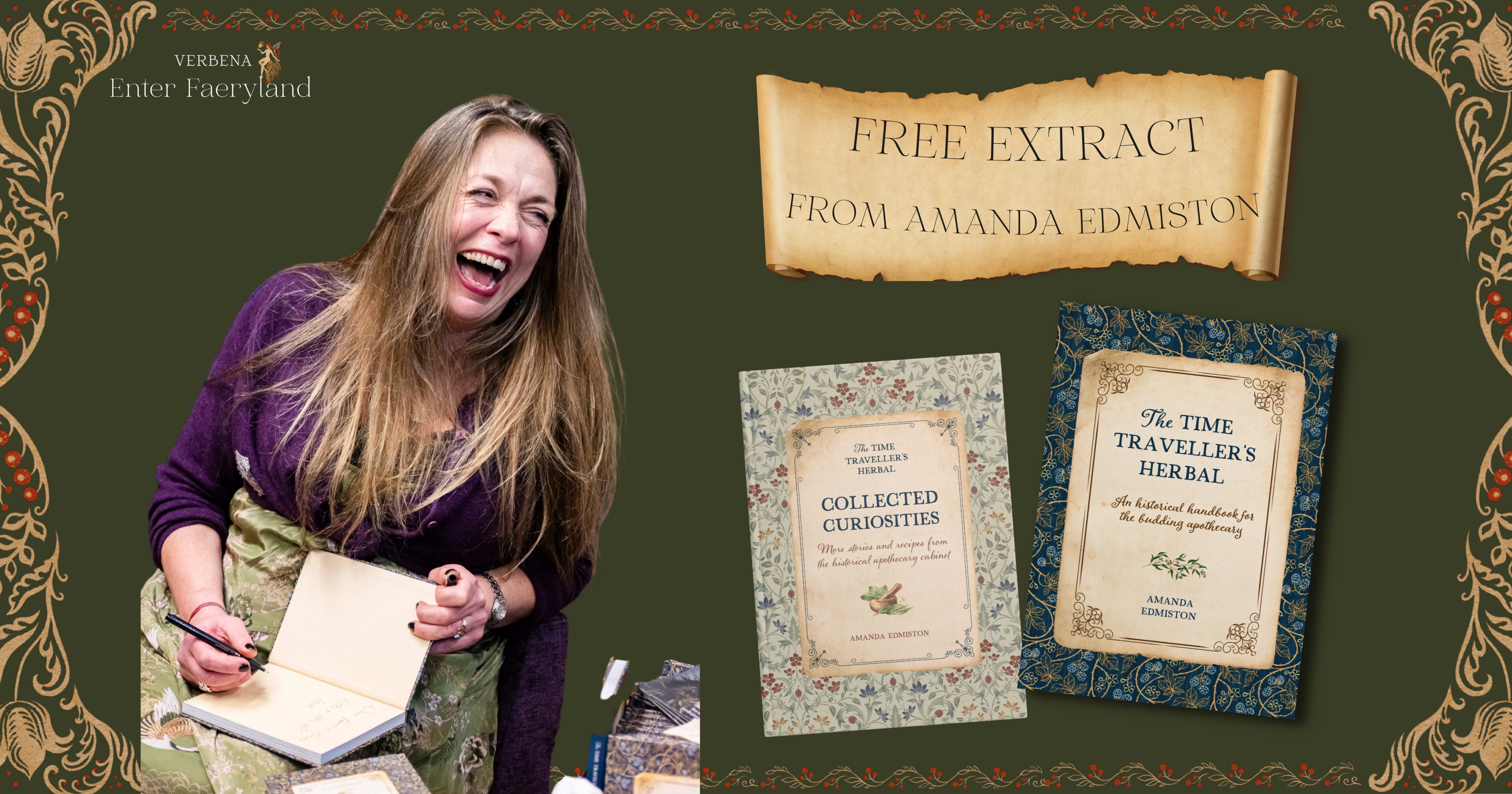
Learn the story of the Scottish minister who died proving the existence of the otherworld, and find a recipe for ointment to see the fae from The Time Traveller's Herbal by Amanda Edmiston!


Are you one of the few brave souls that would like to see the fae for yourself?
If so, you’re in luck. Today, we’re sharing a recipe from The Time Traveller’s Herbal by Amanda Edmiston~BotanicaFabula for an ointment that will allow you to see the fae; but first, learn the story of the man who knew too much…
(If you didn’t already know, we’re celebrating midsummer by sharing faery folklore, book extracts and bonus stories from a range of our authors here at Verbena throughout July! Subscribe for free to receive more magical stories directly to your inbox.)
If you feel you may be seeing people not-quite-there, an ethereal presence shifting in and out of your peripheral vision, you are not alone...
For we may have slipped through time again into the company of the first person to translate the bible into Gaelic. A minister who believed in many things beyond the boundaries of his kirk. A man who was intent on proving and then exploring the world of the sidh or fae, the good folk, in part due to his studies as a folklorist, in part to prove to the atheists of the time – intent on discrediting the church – that if the faerie folk existed, then so must angels and devils. His aim: to unveil a cohort of sentient life-forms, parallel to humanity, but each realm of beings subtly different in make-up.
In time, we will become acquainted with The Reverend Robert Kirk of Aberfoyle – a man who famously appeared one last time as an apparition. He will whisper his story to us soon, but first we need to take stock of our surroundings.

We have not stepped too many miles from the meadow, but we are now within reach of Little Faun falls. This beautiful waterfall is said to be home to an Urisk, a creature I half-jokingly describe as the supernatural long haired environmentalist of seventeenth century Scottish folklore. For here is a being seeking to protect the natural environment, in days when landowners planted trees for personal profit, just ahead of the times when they would start removing people in favour of sheep.
The waterfall descends from a hill, surrounded by hills. Hills clad in protective rowan, cleansing birch, Douglas fir and Scots pine, their evergreen needles symbolising longevity and immortality.
Back in our own time, we will have heard the voices of the evidence-driven experts say that these even, somewhat symmetrical, hills are often the sites of iron age hill forts, or sometimes Pictish earth works. They might be village sites, but sometimes there are no other clues, just a strange semi-sphere, rising from a field. If it’s topped by an oak, an ash and a thorn... well then, it’s fair to ponder that it might indeed be a fairy hill.
This one at the edge of Robert Kirk’s parish is Doon hill, and as we follow the learned man past the village and the kirk towards it, we realise he is taking copious notes, observing his surroundings. It is twilight, and he is remarking to himself as he writes that this is the best time of the day to see them. That they are astral, changeable beings and of a nature a little like condensed clouds. He stops and looks to a field of oats, muttering that they steal the corn like the crows and mice. But he also concedes that some of their ilk, the brownies, help around the house, undertaking domestic duties, and that while they may steal the corn when doing so, they may also leave the ricks more copious than they were before.
He writes that the fairy howe by his church is believed by the superstitious of his parish to be where the souls of their predecessors dwell. It’s a spot dedicated by the church and its graveyard to receive the departed, thus becoming a fairy hill. For at this time the Reverend Robert Kirk is writing, not a bible on this occasion, but a treatise on the ‘Secret Commonwealth’, the world of elves, fauns and fairies.
He must be near the end of his work as he leaves a full notebook, stuffed with extra pieces of paper, on the table of the manse house by the church, and starts to walk towards the domed hill. As we also begin to ascend, we notice hazelnuts ripening on the boughs of small trees and note the scent of wild thyme as our legs brush through the undergrowth. Something compels us to gather a few stems, a nut or two as we go... and we lose sight of the minister as he continues upwards along a twisting path.

There is something enchanted about this place, so we stop to share stories of folk who have encountered the fae, such as Thomas A’ Rhymer, of Ercildoune in the Borders, who shared a beautiful sonnet with the fairy queen and was reward ed with an apple containing the gift of prophecy. Although, for his trouble, he lost seven years in the mortal world. Or the farmhand from the village of Killin in the Perthshire highlands, who fell asleep on a fairy knowe and when he awoke at sunset saw a couple cooking, though they didn’t see him. He accidentally got a speck of hot porridge from their pot in his eye and could see the fairies from then on... until he saw The Wild Hunt pass through the town and the ethereal beings realised they were visible to him and put out his eye. Or the lady who conjured an enchanted dress of fairy green so as to capture the heart of a lover and who fell at her wedding never to return, her grave now marked by a stone that birls at midnight on hallowe’en. A shiver goes through our group. The moon has risen, darkness envelops the land and we are talking too much of the good folk... maybe we should hush.
As morning arrives, we are awoken by a clamour. The minister has been discovered inert on the hilltop. Whispers go round that he knew too much, he has been stolen away by the fae.
As the weeks pass the minister is buried, a stone marking his grave, but then he appears as the banns are read for his cousin’s wedding. He moves away from any embrace and tells his relative that he has been taken away by the good folk, but there is one chance to restore him. He will appear at the wedding and the cousin must throw his dirk, a ceremonial knife, at his form. Freeing him from the spell.
Sure enough a few weeks later, the minister appears again, but the cousin cannot throw a knife at the man he values as a friend and Robert Kirk is never seen again. His body so the story goes is not within his grave. Instead the coffin is said to be filled only with stones...
The Reverend’s work is gathered up and locked in a wooden box... we know the family passes it on, through the generations, until one day, it will be published – the work of a man who knew too much and was stolen away by the fae.
A Lotion To Enable One To See The Fairies: Use If You Dare…
(Do not expect a counter-bought modern ointment – this is more of an emulsion. If you grind the ingredients down they will help to blend the oil and water. I will not translate it, but share this recipe with you as I wrote it down…)
Take a pint of sallet oyle and put it into a vial glasse; and first wash it with rose-water and marygolde water.
The flowers to be gathered towards the east.
Wash it till the oyle becomes white, then put it into the glasse, and then put thereto the budds of hollyhock, the flowers of marygolde, the flowers or toppes of wild thyme the budds of young hazle, and the thyme must be gathered near the side of a hill where fairies use to be;
and take the grasse of a fairy throne; then all these put into the oyle in the glasse and sette it to dissolve three dayes in the sunne and then keep it for thy use.
That is quite enough for today’s venture into the realm of the fae - we don’t want to do too much to draw their attention, after all…
Step into the spiral of time and discover the traditional remedies and recipes passed down through the ages with The Time Traveller’s Herbal, available to order from Amanda Edmiston herself at the link here!

You can find Amanda on Substack here:
Stay tuned for our next venture into the realm of the fae later this week!
 | A guest post by
|